
Legal | Tax | Compliance
Legal | Tax | Compliance
From 27 September 2026, stricter EU information rules apply to B2C traders, including Swiss companies selling to consumers in the EU single market.
As of 27 September 2026, stricter information obligations will apply throughout the EU for B2C traders, both in brick-and-mortar stores and in online commerce. These new requirements will also affect Swiss companies that market their products to consumers within the EU single market.
The new information obligations arise from the so-called “Empowering Consumers Directive” (Directive (EU) 2024/825 amending Directives 2005/29/EC and 2011/83/EU as regards empowering consumers for the green transition through better protection against unfair practices and better information, “EmpCo,” see also here regarding protection against misleading advertising claims in the context of sustainability advertising). Through Implementing Regulation (EU) 2025/1960 of 25 September 2025, the European Commission has specified the design and content of the harmonised notice on the statutory legal guarantee and the harmonised label for commercial durability guarantees. These requirements will apply from 27 September 2026.
Overview of the New Information Obligations
The EU legislator requires traders to inform consumers, in a clear and comprehensible manner before the conclusion of a contract, of the existence of a statutory legal guarantee for goods, including its key elements. This information obligation must be fulfilled by using the following harmonised notice that is valid throughout the EU:
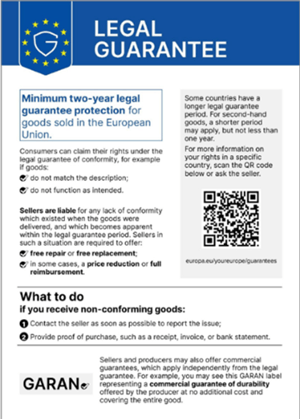
The harmonised notice on the statutory legal guarantee must be displayed prominently in brick-and-mortar stores, for example near the checkout area. In online commerce, it must be made available on the seller’s website as a general reminder.
Where a manufacturer offers a commercial durability guarantee of more than two years for an entire product at no additional cost, consumers must be informed of this guarantee through a harmonised “guarantee label”. This label must contain the prescribed information:
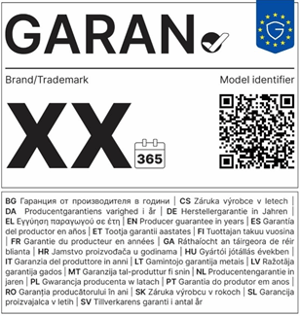
In stores, the guarantee label must be displayed prominently on the product itself, on its packaging, or on the shelf. In online commerce, it must be shown directly next to the product image.
The EmpCo also introduces additional requirements regarding information on the repairability of products. The aim is to enable consumers to make more sustainable purchasing decisions.
Traders selling goods with digital elements, providing digital content or digital services are now required to inform consumers of the minimum period during which software updates will be provided, given that this information has been supplied by the manufacturer or service provider.
The new information obligations will also affect Swiss companies that distribute, or have others distribute, their products to consumers in the EU single market.
Breaches of these information obligations, including missing or insufficient disclosures, may qualify as unfair commercial practices. Such breaches may result in injunction claims, claims for damages, and enforcement measures by market surveillance authorities.
The new EU obligations significantly strengthen transparency requirements under consumer protection law. Manufacturers and traders, including Swiss companies, should promptly assess their compliance with the new requirements and implement any necessary measures, as the new rules will apply from 27 September 2026.


