
Legal | Tax | Compliance
Legal | Tax | Compliance
In 2025, the EU simplified ESG regulations and lowered barriers with various initiatives, particularly in the areas of reporting and due diligence.
ESG changes in 2026: What do Swiss companies need to bear in mind?
In 2025, the EU simplified ESG regulations and lowered barriers with various initiatives (known as "omnibus procedures"), particularly in the areas of reporting and due diligence. The EU's goal is to become more competitive.
Switzerland has also put the further development of its ESG regulations «on hold” and is expected to decide in spring which adjustments or extensions to the existing ESG obligations in Switzerland will be made.
Is "wait and see" the right approach? Unfortunately, not. Rather, forward-looking action is required to avoid being pressed for time.
What do Swiss companies operating in the EU need to bear in mind?
ESG reporting (CSRD)
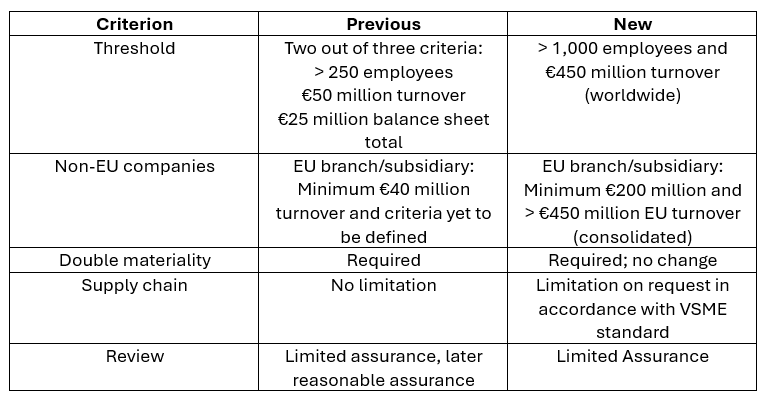
Non-EU companies with significant business activities in the EU will be required to publish a sustainability report in accordance with CSRD standards for the first time in 2029 for the 2028 financial year.
The prerequisite for this is that either an EU subsidiary or branch exists that generates at least €200 million in turnover and the company's total consolidated EU turnover amounts to at least €450 million.
The requirements aim to create a level playing field for EU and non-EU companies and to increase transparency with regard to sustainable business practices.
In addition, the obligation to perform a double materiality analysis remains in place, requiring both financial and environmental and social impacts to be taken into account. Non-EU companies will therefore have to take a closer look at their reporting and the sustainability risks within their supply chains in future.
Companies subject to reporting requirements may not demand information from small suppliers (<1,000 employees) – regardless of whether they are incorporated in the EU or outside it – that goes beyond the VSME standard (Voluntary Sustainability Reporting Standard for SMEs). Suppliers can refuse to provide additional information. The VSME standard, which has not yet been definitively adopted, will therefore gain in importance.
Overview of the most important CSRD changes
Due diligence obligations (CSDDD)
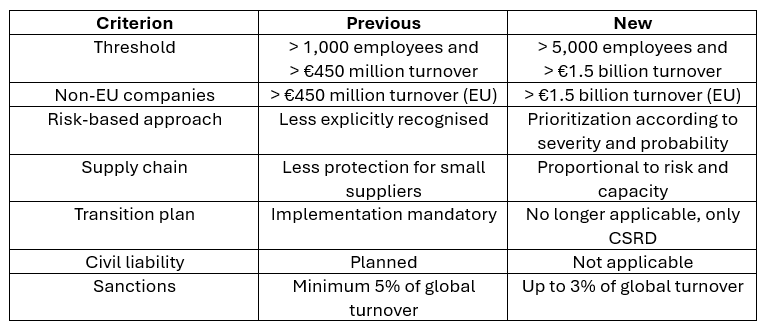
The CSDDD is now scheduled to come into force in July 2029, instead of July 2027 as originally planned.
The CSDDD now only applies to companies with more than 5,000 employees and global turnover in excess of €1.5 billion. For companies outside the EU, turnover within the EU must exceed €1.5 billion, regardless of the number of employees.
Smaller suppliers will also be protected under the CSDDD in future. Small and medium-sized enterprises (SMEs) will only have to provide information if this is absolutely necessary to fulfil their due diligence obligations. Companies can tackle the biggest risks first; they do not necessarily have to prioritize Tier 1 suppliers.
The obligation to draw up transition plans and civil liability are no longer applicable. Reports on transition plans only need to be submitted under the CSRD.
Penalties of up to 3 per cent of global turnover may be imposed.
Overview of the most important CSDDD changes
Product sustainability
EUDR
The European Union's Deforestation Regulation (EUDR; see also our magazine article "Impact of the EU Deforestation Regulation (EU) 2023/1115* on Swiss companies") has been officially postponed. The amendments to the regulation were published in the Official Journal of the EU on 23 December 2025 and officially entered into force on the third day after their publication.
The key change concerns the simplification of the due diligence procedure. In future, responsibility for submitting the required declaration will lie solely with the companies that place products on the EU market for the first time. Downstream operators will only have to store the reference number of this declaration; it will no longer be necessary to pass it on. For micro and small enterprises, the obligation is reduced to a one-time simplified declaration. These businesses receive a unique identifier that is sufficient for traceability and significantly reduces the bureaucratic burden.
At the same time, the application of the regulation will be postponed again by one year. The EUDR will now only apply to all companies from 30 December 2026, with micro and small enterprises receiving an additional six-month buffer. In addition, the European Commission is to submit a report on further simplification, including possible legislative proposals, by 30 April 2026.
CBAM
After a two-year transition phase with reporting only since October 2023, the EU Carbon Border Adjustment Mechanism (CBAM) will enter its regular phase on 1 January 2026 (see also our magazine article "CBAM – Imports from Switzerland to the EU only with CBAM certificates?").This also marks the start of financial obligations for importers.
CBAM applies to iron and steel, aluminum, cement, fertilizers, electricity, and hydrogen, among other things.
A new 50-ton threshold applies: Companies that import less than 50 tons per year in the product groups cement, iron and steel, aluminum, and fertilizers are exempt from registration and obligations. Importers of CBAM goods exceeding 50 tons must be registered as authorized CBAM declarants, verify emissions or use default values, and purchase CBAM certificates retroactively from February 2027.
The European Commission has announced the publication of a series of proposed amendments to the CBAM, including the extension of the scope of the CBAM to some downstream products in order to prevent EU manufacturers from relocating production to countries with weaker climate protection measures.
Currently, the CBAM targets raw materials such as aluminum, cement, electricity and steel, which increases costs for EU manufacturers and risks the relocation of production of downstream products to other countries.
Under the Commission's new proposal, the scope of the CBAM would be extended to certain steel- and aluminum-intensive downstream products. The proposal covers 180 products with a high risk of carbon leakage and a high content of steel or aluminum, such as machinery, hardware and finished products, vehicle components, household appliances and construction machinery.
Greenwashing and Empowering Consumers Directive
Based on current information, there will probably not be a majority in the European Parliament and Council of Ministers in favor of the Green Claims Directive. The directive aims to better protect consumers from false claims relating to environmental statements.
Another directive, the Empowering Consumers Directive (EmpCo), already prohibits misleading advertising claims or other practices that could unfairly influence consumers in their purchasing decisions. It has concrete implications: for example, companies are not allowed to label products as "climate neutral" if the company has merely purchased CO2 compensation certificates for them.
In Switzerland, Art. 3 lit. x Unfair Competition Law (UCL) has been in force since January 2025: In particular, it is considered unfair to "make statements about oneself, one's works or services in relation to the climate impact caused that cannot be substantiated by objective and verifiable evidence."
Violations of the UCL can have civil and criminal consequences. Not only competitors, but also customers, professional and trade associations, and consumer protection organizations are entitled to take legal action (see also our magazine article "Greenwashing – what companies should consider").
Governance, risk and compliance (GRC) health check
The foundation of any ESG and sustainability activity is the company's governance, risk and compliance structure.
With our "GRC Health Check", we have developed a pragmatic tool to conduct an initial assessment of existing structures and to make recommendations for measures to close gaps.
Recommendations
Simplification of ESG requirements? Yes, but...
The changes bring greater clarity, longer preparation time and a more risk-based approach to sustainability and due diligence. However, companies should start adapting their processes at an early stage.
The basic principle still applies: reporting does not equal sustainability! Only the pragmatic and cost-effective implementation of effective measures will lead to greater sustainability. Reporting comes at the end of the process. Clear documentation of facts and statements reduces the risk of greenwashing!
We recommend that Swiss companies that are suppliers to EU reporting-obligated companies implement the VSME standards and report accordingly. This simplifies reporting and can be implemented pragmatically (see also our magazine article "Voluntary sustainability reporting made more pragmatic and cost-efficient").
An effective governance, risk and compliance concept is equally important for managing and monitoring sustainability efforts.
Our ESG team would be happy to talk to you.
Click here to learn more about our expertise:

